One Noise Complaint. Remove the Floor?
Carpet has been replaced with hybrid timber flooring. Five early-morning noise incidents are reported, approval records are missing and the committee demands removal. You are the strata manager. What would you do?
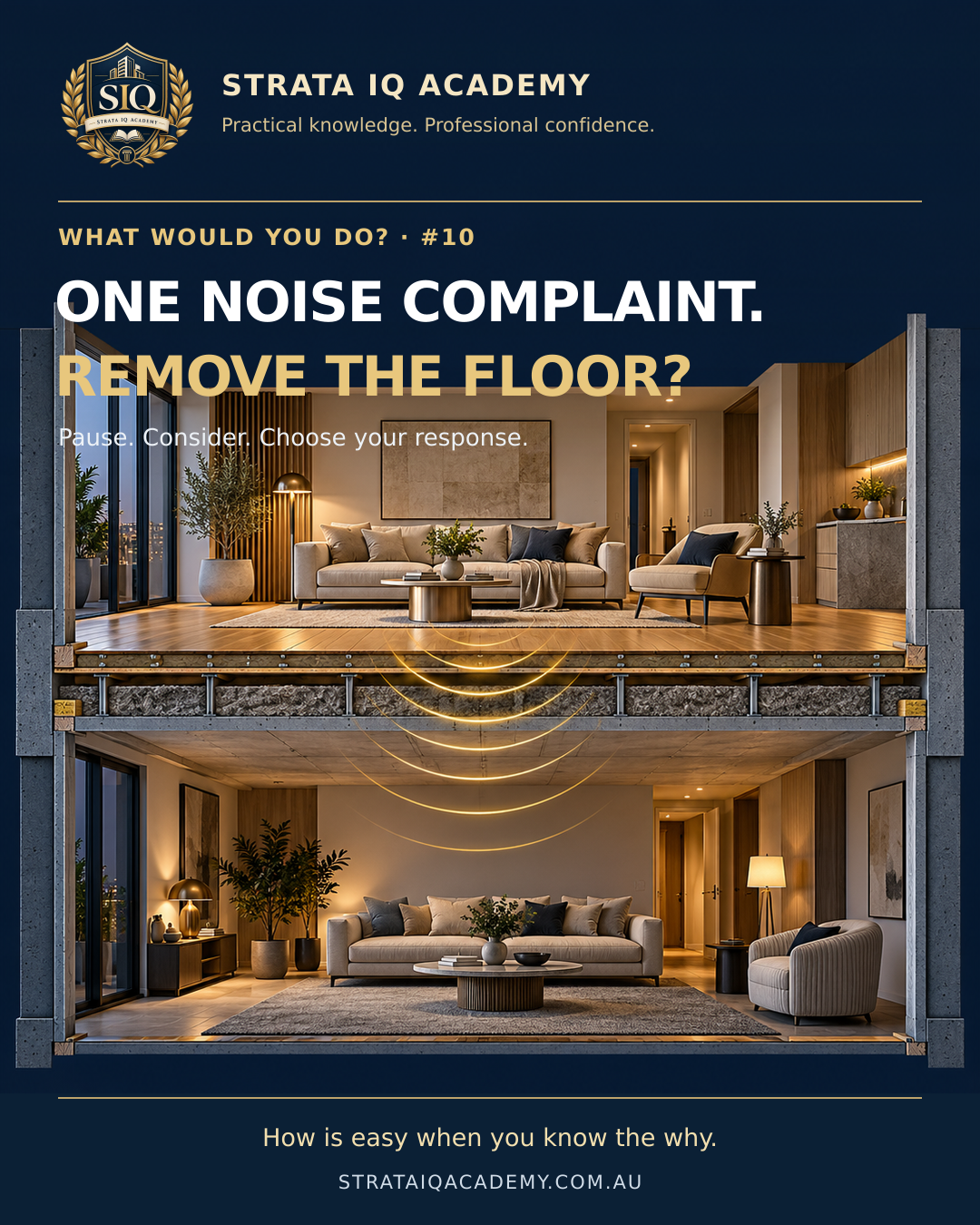
Six weeks ago, an upstairs owner replaced carpet with hybrid timber flooring.
The downstairs owner has now complained about footsteps and impact noise, recording five early-morning incidents.
The flooring installer says the acoustic underlay complies with the required standard.
However, the strata records contain no renovation approval or acoustic report for the installation.
The downstairs owner wants the floor removed.
After receiving the complaint, the strata committee instructs the strata manager:
“Tell the owner to remove the flooring immediately.”
You’re the strata manager.
WHAT WOULD YOU DO?
What would you recommend?
- AIssue a Notice to Comply immediately and demand that the flooring be removed.
- BReject the complaint because the installer says the acoustic underlay complies.
- CPause the removal demand, check the registered by-laws and renovation approval history, investigate the noise evidence, give the upstairs owner an opportunity to respond and confirm the appropriate decision-making authority before recommending action.
- DTreat it as a private dispute between the two owners and tell them to resolve it themselves.
A, B, C or D? And more importantly — WHY?
Reveal the practical explanation
Investigate the complaint before deciding on a remedy.
The complaint should be investigated, but the committee should not assume that a complaint automatically establishes a by-law breach or justifies directing an owner to remove flooring.
There are two potentially separate issues. First, renovation approval: was the carpet-to-hybrid-flooring replacement properly approved under the applicable NSW strata renovation provisions and the scheme’s registered by-laws? Second, noise compliance: is the flooring causing noise that contravenes an applicable by-law or otherwise warrants action under NSW strata law?
Know the by-law and check the approval
Obtain the current registered by-laws. Review the flooring application, plans, approval conditions and available installation records. Request the relevant acoustic documentation and specifications. The records gap needs investigation; do not assume that a missing document proves every aspect of an alleged breach.
NSW Government guidance distinguishes laying carpet from installing or replacing hard flooring, including removing carpet. Check the actual scope of work and the applicable approval pathway, including any valid authority delegated to the committee. Approval history and noise compliance are separate questions. Neither an approval nor the installer’s assurance automatically settles the other issue.
Examine the evidence and hear both owners
Review the five reported incidents: dates, times, frequency, duration and descriptions. Ask what was heard, where it was heard and what records are available. Give the upstairs owner a reasonable opportunity to respond.
Consider an appropriate acoustic assessment where the circumstances justify it, with proper authority for its scope and cost. The relevant by-law, approval conditions, installation details and assessment method matter. There is no universal acoustic decibel threshold to invent for every scheme, and the installer’s statement does not by itself prove compliance.
Good practice may include an agreed interim measure, such as rugs or changes to early-morning activity, while the evidence is checked. An interim agreement should not be presented as a final finding of breach.
Confirm authority before issuing a formal notice
Section 146 of the Strata Schemes Management Act 2015 requires a Notice to Comply to identify the relevant by-law, contain a copy of it and use the approved form. The owners corporation must be satisfied that the person has contravened that by-law. A notice is not a shortcut from an allegation to a flooring-removal order.
Check the authorisation requirement before giving the notice: an owners corporation or strata committee resolution is generally required, subject to applicable statutory exceptions, including a valid delegation of this function to the strata managing agent. Check the scheme’s circumstances and the scope of any delegation. A committee instruction alone does not answer every question about the power to require removal.
The manager should recommend a proportionate response supported by the evidence and confirm who can make the relevant decision. Where a binding remedy or order is needed, obtain suitable advice about the correct application and authority rather than treating a removal demand as self-executing.
Use the appropriate pathway if the dispute remains unresolved
Early communication may help. If the issue remains unresolved, consider NSW Fair Trading mediation and, where appropriate, NCAT. Check the requirements, available orders and any mediation prerequisite or exception for the particular application.
Do not dismiss the matter as purely private without checking the scheme’s by-laws and responsibilities. Equally, do not treat a single complaint as an automatic entitlement to a particular remedy.
Fair investigation protects both residents and the decision
The downstairs owner deserves a fair response. The upstairs owner deserves an opportunity to answer the concern. A defensible decision connects the registered rule, approval history, evidence, authority and proportionate next step.
Prepare a short decision record: the registered by-law, approval material found, evidence still needed, the person or body authorised to decide and the date both owners will receive an update.
STRATA IQ TAKEAWAYA complaint starts an investigation. It does not automatically establish a breach. KNOW THE BY-LAW. CHECK THE APPROVAL. EXAMINE THE EVIDENCE. THEN DECIDE. How is easy when you know the why.
NSW Government noise and renovation guidance and its linked approved Notice to Comply form rechecked 6 November 2026. Statutory references reconciled with the supplied Act as at 23 October 2026. Direct retrieval of the latest official Act consolidation and AustLII remained unavailable; this review does not claim a fresh retrieval of that consolidation. Investigation, response opportunities and proportionality are practical recommendations; formal notice and approval requirements depend on the applicable law and scheme documents. Independent NSW strata education, not government guidance or advice on a particular dispute. Check current law and scheme documents before acting.
- NSW Government — Noise in strata ↗
- NSW Government — Strata renovation rules ↗
- NSW Government — Strata by-laws ↗
- NSW Government — approved Notice to Comply form and authorisation guidance ↗
- Strata Schemes Management Act 2015 — sections 110, 146 and 153 (current retrieval outstanding) ↗
- NCAT — strata and community schemes applications ↗
Turn the explanation into practice.
Open the linked Guide or Academy pathway when you need the complete checks, official sources and practical learning.