Who Is Responsible for a Water Leak in NSW Strata?
A practical NSW guide to controlling the immediate risk, identifying the source and separating repair responsibility from insurance and damage claims.
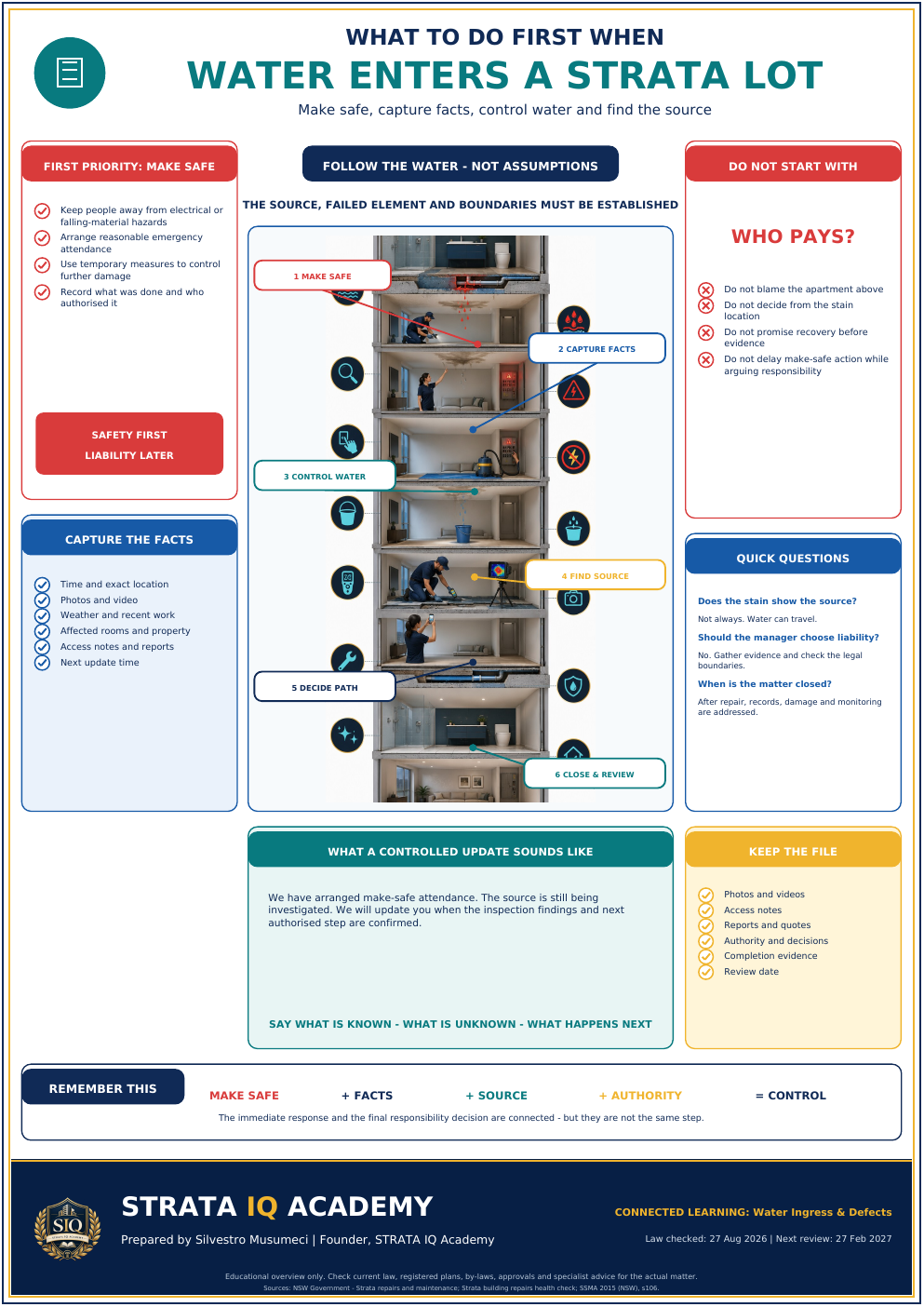
Stop the damage and make the area safe before arguing about who pays. In NSW strata, responsibility usually follows the source of the water, the failed building component, the strata plan, registered by-laws and any renovation or common-property rights obligations. The place where water becomes visible does not, by itself, decide responsibility. Keep immediate risk control, source repair, restoration and insurance as four separate questions.
What you need to know
- The place where water appears is evidence of impact—not proof of the source or legal responsibility.
- Immediate mitigation is not an admission of liability. Control safety and preventable damage first, within authority.
- Source repair, restoration of damage, insurance response and any recovery action may sit with different parties.
What current NSW law says
- Section 106 of the Strata Schemes Management Act 2015 requires an owners corporation to properly maintain and keep common property in a state of good and serviceable repair, and to renew or replace common-property fixtures and fittings where necessary.
- NSW Government guidance states that owners corporations repair and maintain common property, while owners repair property within their lot. It also warns that the strata plan and registered by-laws must be checked because boundaries and responsibilities can differ.
- Section 122 of the Act provides an owners corporation with powers to enter property to carry out work required under the Act. The statutory notice and emergency rules must be followed for the actual circumstances.
- A lot owner may have a statutory damages claim for reasonably foreseeable loss caused by an owners corporation's breach of its section 106 duty. The Act contains a six-year time limit linked to when the owner first becomes aware of the loss. Legal advice should be obtained before stating or responding to a claim.
Legal foundation: These provisions guide the responsibility assessment. They do not allow responsibility to be decided from a photograph of a wet ceiling or simply because water appeared below another lot.
The five-minute water-ingress framework.
1. Control the immediate risk
Treat active water near electricity, ceilings, lifts, fire systems or access paths as a safety issue first. Keep people away from the affected area, follow the building's emergency procedure and arrange an appropriately licensed trade within the available authority. Mitigation is responsible risk control, not an admission of liability.
2. Record what is happening
Record the time reported, affected areas, whether water is active, photographs or video, access attempts, temporary controls and the people notified. Ask the contractor to record what was observed and tested, any immediate work performed and what further investigation is needed. Avoid broad conclusions unless the technical evidence supports them.
3. Find the source and failed component
The source may be a pipe, fitting, appliance, waterproofing membrane, roof, balcony, facade, window, drain or building service. Use investigation proportionate to the issue. Persistent or disputed ingress may require moisture mapping, controlled testing or specialist waterproofing, hydraulic, facade or engineering input. Destructive testing needs proper authority, access and scope.
4. Map the evidence to responsibility
Once the source is reasonably established, check the registered strata plan and boundaries; registered by-laws; renovation approvals, plans and conditions; maintenance and prior-leak history; applicable warranties; and both the owners corporation's and lot owner's insurance arrangements. Then separate source repair, restoration, insurance and recovery.
5. Authorise, communicate and close the loop
Confirm who has authority for temporary controls, investigation and permanent repair. Tell affected people what is known, what remains unconfirmed, what happens next, who owns the action and when the next update will be provided. Keep the matter open until the source is repaired, affected areas are dry, restoration and insurance are addressed, and final evidence is filed.
The repair failed. What should we check next?
Why this check matters
A repeat symptom does not establish that the same component failed, that the earlier contractor was negligent or that the next repair is identical. It does justify joining up the history before commissioning another permanent solution.
Legal context: section 106(1)–(2) sets the owners corporation’s common-property maintenance, renewal and replacement duties. Check the plan, applicable by-laws and section 106 qualifications for the actual property. Do not let the investigation become an excuse to leave an immediate risk uncontrolled.
Before seeking the next repair price
- Protect people and property: establish active risk, arrange authorised interim controls and preserve evidence where practical.
- Rebuild the chronology: put reports, photos, tests, approved scope, variations, invoices, completion evidence and recurrence dates together.
- Test the earlier scope: was it diagnosis, a temporary seal, a local repair or a system replacement? The invoice description may not answer that question.
- Ask a competent adviser: what cause remains unproven, what testing is proportionate, and does the pattern extend beyond this location?
- Define closure: agree the repair scope, appropriate testing, evidence, maintenance instructions and review date. Keep rights, warranty terms and any limitation period under separate review with suitable advice.
The same stain, a different question
A stain returns below a balcony six months after a local sealing job. The committee asks for the same contractor to repeat the treatment. The previous report did not establish the water pathway.
Consider the practical response
Keep the affected area safe and check whether temporary protection is needed. Give the qualified adviser the old scope and evidence alongside the new observations. Ask whether the source is the same and what further investigation is needed before another permanent repair. Contacting the earlier contractor can assist with records; it does not decide liability, warranty coverage or a legal right to return.
A useful instruction to the adviser
Please review the attached history and identify what the previous work addressed, what remains uncertain and the investigation needed to support a lasting repair. Please separate immediate controls, recommended permanent work, testing and future maintenance.
Keep one linked record
Checklist: current risk · previous scope · chronology · technical question · authority and funding · verification evidence · future maintenance · next review.
Use the existing sewer incident workshop to practise follow-through and the Water Ingress First Response visual guide for immediate triage. These are connected resources, not separate competing defect registers.
Sources and review — 21 October 2026
NSW only. Current official provisions and the listed government guidance reviewed on 21 October 2026. The practical method and fictional examples are Academy wording. No case outcome, proposed reform or Queensland rule is presented as NSW operational law.
Use this only as a starting point.
| Situation | Likely starting point | What must still be checked |
|---|---|---|
| Roof, gutter, boundary-wall pipe, concrete slab or common-property plumbing | Owners corporation investigation and repair duty may apply | Strata plan, by-laws, cause, alteration history and expert evidence |
| Tap, flexible hose, appliance or fixture serving only the lot and located within lot property | Lot owner responsibility may apply | Boundary position, installation, maintenance, renovation approval and causation |
| Bathroom or balcony waterproofing | Do not assume | Original construction, boundaries, registered by-laws, renovation obligations, defect history and technical report |
| Water enters one lot from another lot | Source must be investigated | The source may be lot property, common property or an approved renovation obligation |
| Resulting internal damage | Separate from source repair | Cause, ownership of damaged item, mitigation, insurance cover, excess and any recoverable loss |
| Newer building with repeated or serious ingress | A defect pathway may also apply | Warranty dates, Building Commission pathway, expert evidence, limitation dates and legal advice |
Every entry is provisional until the evidence, strata plan and registered by-laws are checked.
Watch for
- Deciding responsibility from where the stain appears
- Waiting for a liability agreement while active damage continues
- Treating an insurance claim as a substitute for repairing the source
- Allowing undocumented temporary work to become the permanent solution
- Assuming every bathroom leak belongs to the upstairs owner
- Overlooking a renovation by-law, warranty, repeated-failure pattern or statutory deadline
- A strata manager or committee member giving a technical conclusion outside their competence
Escalate when
- Water is active near electricity, a ceiling, lift, fire system or access path
- The source, boundary or responsible component remains disputed
- Access is refused or destructive investigation may be required
- A serious or repeated defect, substantial loss, insurance dispute or limitation period may be involved
Clear answers before you act
Is the upstairs owner automatically responsible for a bathroom leak?
No. The water may come from an owner-maintained fixture or appliance, but it may also involve waterproofing, a slab, a boundary-wall pipe or other common property. The source, failed component, strata boundaries and renovation obligations need to be checked.
Can the owners corporation wait until responsibility is agreed?
It should not allow an active safety risk or preventable damage to worsen while responsibility is investigated. Immediate mitigation and permanent liability are separate issues. Act within authority, preserve evidence and avoid admissions.
Does lodging an insurance claim decide who must repair the leak?
No. Insurance may respond to resulting insured damage, subject to the policy. It does not replace the obligation to locate and repair the source or automatically determine property responsibility or legal liability.
Who pays the insurance excess?
Do not assume. Check the policy, claim circumstances, registered by-laws, valid owners corporation decisions and current legal advice where disputed. Excess allocation is separate from ownership of the failed component.
Can an owner arrange an emergency repair and seek reimbursement?
NSW Government guidance says an owner may be eligible for reimbursement when the cause was an owners corporation responsibility and the attendance was necessary and urgent. Notify the strata manager where possible, keep photographs and obtain the contractor's written findings and invoice. Reimbursement remains fact-specific.
What if the parties cannot agree?
Put the technical evidence, plan, by-laws, proposed work and required decision before the owners corporation. NSW Fair Trading mediation may assist. Obtain proper advice where access is refused, loss is claimed, limitation periods may apply or the dispute remains unresolved.
Source-controlled learning
Reviewed against the following current official material on 14 September 2026. Open the source to check the latest version before relying on it.
- NSW Government — Strata repairs and maintenance ↗
- NSW Government — Strata building repairs health check ↗
- Strata Schemes Management Act 2015 (NSW) — current version ↗
- NSW Government — Applying for strata mediation ↗
- Building Commission NSW — Design and building practitioners ↗
- Building Commission NSW — June 2026 remedial-work regulation update ↗
A wet ceiling tells you where the water appeared. It does not tell you, by itself, who is responsible.
Control the risk. Find the source. Check the boundary and by-laws. Separate repair, restoration and insurance. Then make and record the decision.
How is easy when you know the why.
Build the complete first-response capability.
Use the Academy course and Roleplay Room to practise risk control, evidence gathering, authority, clear owner updates and reliable close-out.