The Repairs Were Delayed. Does the Owners Corporation Pay Everything?
Common-property repairs are delayed. A commercial tenant leaves, and the owner claims lost rent and other losses. How should the Owners Corporation respond?
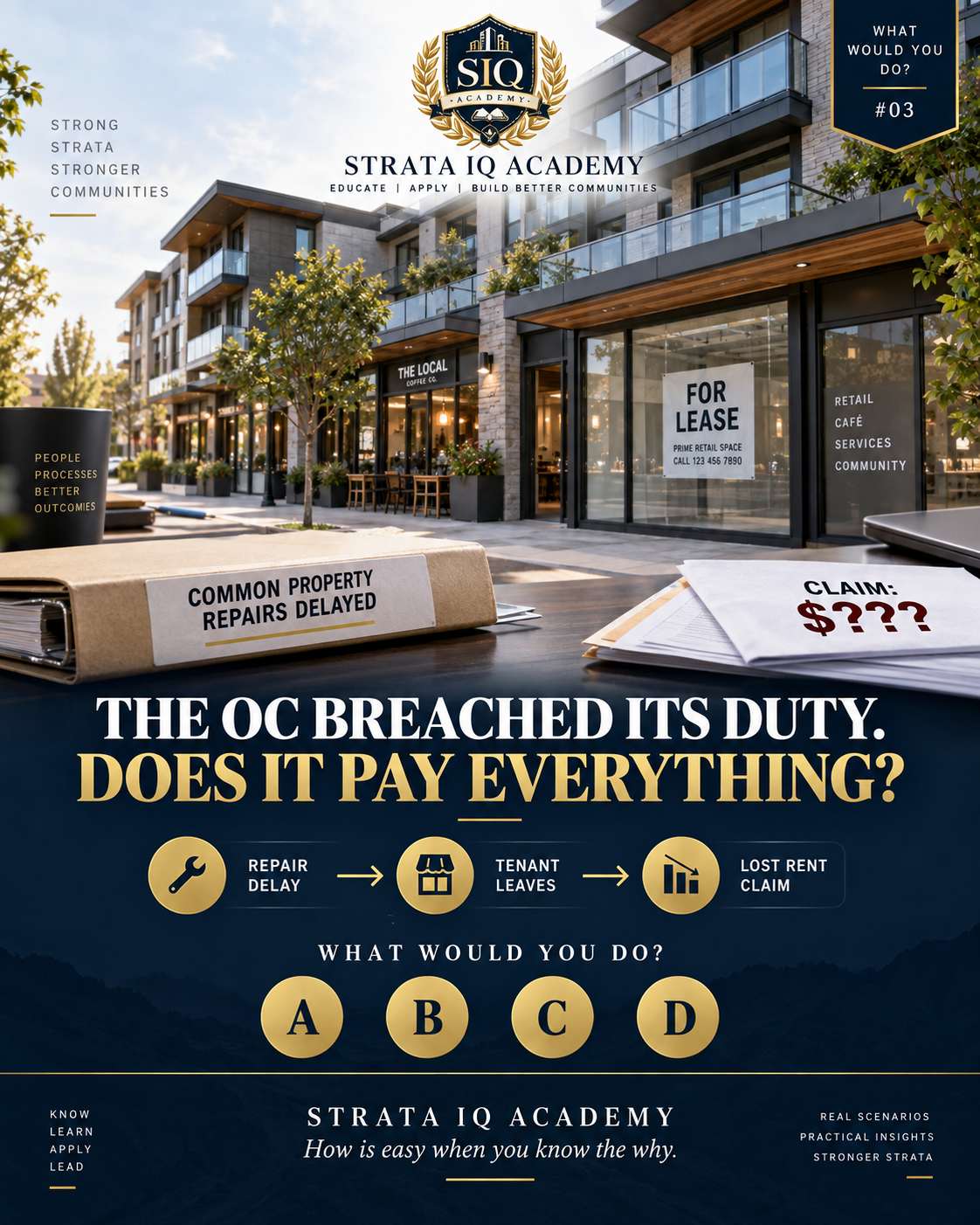
A strata scheme has outstanding common-property and fire-safety works. The repairs are delayed. A commercial tenant leaves. The lot owner then claims substantial lost rent and other losses from the Owners Corporation. The Owners Corporation accepts that the common-property repairs should have been completed earlier. Does a breach of the Owners Corporation’s repair duty mean it must pay the entire claim?
Which option would you choose?
- APay the whole claim because breach has been established.
- BReject the claim because the tenant chose to leave.
- CAssess which losses were actually caused by the breach, were reasonably foreseeable, supported by evidence, and could not reasonably have been avoided.
- DRefer the liability decision to the strata manager.
Choose your response before opening the practical explanation.
Reveal the practical explanation
Establish the loss as well as the breach.
Section 106 of the Strata Schemes Management Act 2015 places a statutory duty on the Owners Corporation to maintain and repair common property. A breach can give rise to a lot owner’s damages claim for reasonably foreseeable loss resulting from that breach. Accepting that repairs were late does not, by itself, establish every item or dollar claimed.
Causation: identify the link between the repair failure and each loss. Examine why the tenant left, the condition and permitted use of the premises, the period affected and any other reasons for the vacancy. A tenant’s decision to leave does not automatically defeat the claim, but it does not automatically establish the whole claim either.
Foreseeability and evidence: assess whether the type of loss was reasonably foreseeable and whether its amount and duration are supported. Retain leases, rent ledgers, termination correspondence, fire-safety orders, expert reports, repair records, invoices and an itemised calculation. Separate actual losses from assumptions and avoid double counting.
Mitigation: consider reasonable steps available to reduce the loss, including realistic re-letting opportunities. The question is what could reasonably have been done in the circumstances, not what appears ideal with hindsight. Do not assume the owner had to accept an unsafe or unlawful use of the premises.
Case example — Hang v The Owners–Strata Plan No 77261 [2026] NSWCATCD 104: the lot owners succeeded in their section 106 claim, but the Tribunal did not award the full amount claimed. The recoverable losses still had to be established. The practical scenario above is simplified for discussion. The decision turns on its evidence; it is not a fixed formula for calculating another scheme’s liability.
Coordinate, document and obtain instructions. The strata manager should assemble the chronology and claim documents, identify the appropriate decision-maker and arrange professional advice. Substantial claims should be referred to the insurer or broker where appropriate, subject to policy notification requirements; cover should not be assumed. The manager should not personally determine disputed legal liability or promise a settlement without authority.
How is easy when you know the why.
Keep the repair response moving while the claim is assessed. A dispute about compensation does not remove the need to address outstanding common-property and fire-safety obligations. Obtain advice on applicable deadlines and the proper decision process.
A fair assessment needs both responsibility and proof.
Option A skips assessment of the loss. Option B assumes the tenant’s departure breaks the connection without examining the evidence. Option D gives the strata manager a legal decision they should not personally make. Option C supports a documented assessment, informed instructions and appropriate professional advice.
BREACH → CAUSATION → FORESEEABILITY → EVIDENCE → MITIGATION → ASSESS THE LOSS
STRATA IQ takeawayA breach can create liability. It does not automatically prove the whole claim.
Source basis: NSW Government repair guidance and the official Hang judgment, including paragraphs 442–464 and the damages assessment. The linked consolidated legislation text was not independently retrieved for this review. This is general education; check the current law and obtain advice for a particular claim.
Turn the explanation into practice.
Open the linked Guide or Academy pathway when you need the complete checks, official sources and practical learning.