Learn
Follow the pathway that matches your role.
Join during the complimentary founding period and keep practical learning, NSW references, workplace tools, progress and certificates together in one secure member space.

How is easy when you know the why.
Join free during the founding period. It takes only a few minutes, and no payment card is required.
We sent a confirmation message to .
No card is required and nothing will be charged automatically.
Search, check a NSW reference, continue learning or open a workplace tool.
iPhone: tap Share, then Add to Home Screen. Android: open the browser menu, then select Add to Home screen or Install app.
New courses, visual guides and tools appear here immediately. Opted-in members receive one concise Monday summary.
Choose the job in front of you and the time you have. The Academy will take you to the right existing learning.
15-minute learning selected. Your recommendation is shown below.
Choose the type of help you need. Every major Academy resource is grouped below.
Follow the pathway that matches your role.
Deal with a live job or practise judgement.
Move from the issue to the current official source.
Continue, review progress or ask for help.

Search practical courses, legislation updates, quick guides and workplace tools built to help strata professionals make better decisions.
 Silvestro’s Tip
Think About It
Watch Out
Well Done
Silvestro’s Tip
Think About It
Watch Out
Well Done
Choose a destination below. You can always return to the dashboard.
Start with what you need today. You can always browse the full catalogue when you are ready.
Choose the route that matches the job in front of you. The Academy will take you to the right depth — quick answer, structured pathway or professional practice.
A repeatable professional method for difficult or unfamiliar matters.
Do not guess. Do not hide uncertainty. Do not commit outside authority.
Ask, record, escalate and follow through. The Academy repeats this standard across every module so staff build judgement, not just memorised answers.
Practical Academy information, tools and working files that members can open, download and use alongside the learning.
Use the guide for general learning, then check the registered building documents and obtain scheme-specific advice where required.
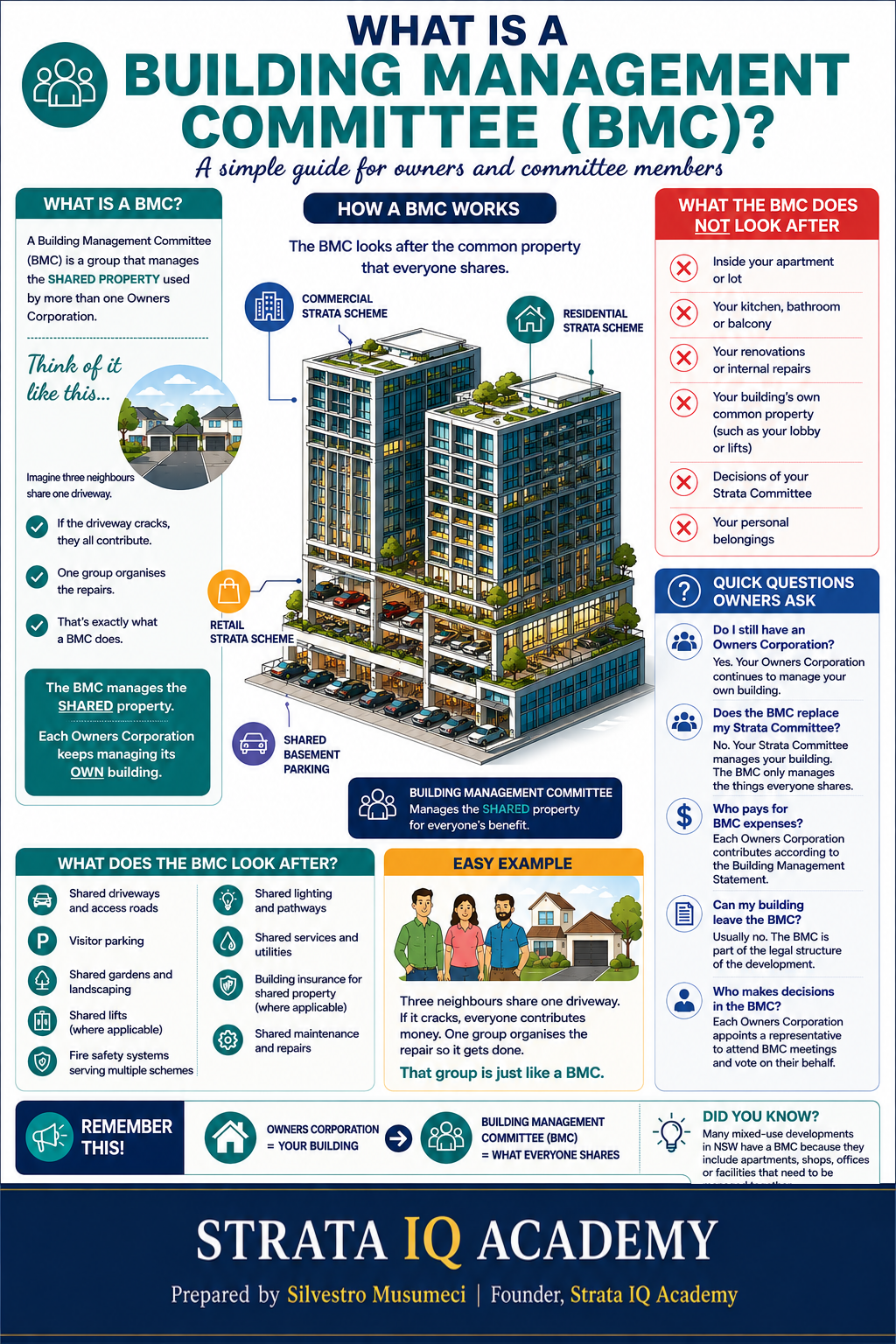
A plain-English visual guide explaining shared property, how a BMC works, what it looks after, what remains with each Owners Corporation and the questions owners commonly ask.
 Visual guide 01
See the usual Owners Corporation and lot-owner responsibilities, the grey areas to check and the five questions to ask before deciding.
 Visual guide 02
Understand the layers, shared association property, registered management statement, decision-makers and separate funding responsibilities.
 Visual guide 03
A practical authority map for checking the decision, law or by-law, delegation, funds and record before work moves ahead.
 Visual guide 04
Classify cosmetic, minor and major work, then gather the scope, plans, impact evidence and conditions before approval.
 Visual guide 05
Move from make-safe and fact capture to source investigation, authorised repair, communication, records and closure.
 Visual guide 06
A controlled overview of issue definition, authority and evidence, resolution, mediation, application, preparation and next steps.
 Visual guide 07
Follow the complete meeting pathway from issue and motion preparation to notice, participation, voting, minutes and professional follow-through.
 Visual guide 08
See the eight SBBIS stages, important inspection windows, evidence controls and the Owners Corporation’s role in monitoring rectification.
 Visual guide 09
Understand approved budgets, unit-entitlement contributions, the two main funds, special-levy decisions and payment-notice controls.
 Visual guide 10
Move from the fire safety schedule and practitioner assessment through rectification, verification, declaration, submission and next-year control.
 Visual guide 11
See the network, compare the total cost, classify supply and common-property motions, protect owner choice and understand individual and whole-scheme exit paths.
 Visual guide 12
See who reports defects, how the two statutory-warranty periods differ, when experts and lawyers should become involved, and how the Owners Corporation preserves evidence and deadlines.
 Visual guide 13
See who must complete the NSW Fair Trading training, the exemptions, the two-month reminder, three-month deadline, certificate record and non-completion pathway.
 PDF · 14 pages
A friendly NSW orientation guide covering committee roles, authority, meetings, money, repairs, records and working effectively with a strata manager.
 PDF · 12 pages
A deeper practical companion covering the BMC structure, authority, representatives, costs, decisions, common misunderstandings and NSW source controls.
 PDF · Committee guide
A one-page decision guide for NSW strata committees: when to stop, what to check, which records to retain and why scope-specific advice matters.
 PDF · 11 pages
The full participant handout covering the DBP scheme, practitioner roles, regulated work, workflow controls, exclusions, scenario practice and official sources.
 XLSX · Calculator
Prepare a dated funding picture from available cash, expected income, creditors and upcoming costs, then calculate lot allocations for a proposed special levy.
 XLSX · Calculator
Allocate a selected levy amount across lots using the entered unit-entitlement schedule, with totals and variance checks built into the workbook.
 XLSX · Portfolio tool
A multi-sheet working system for portfolio registration, daily priorities, AGM planning, defects and warranty tracking, manager inputs and action visibility.
XLSX · Compliance register
Track appointment dates, exemptions, two-month reminders, three-month deadlines, certificates, overdue members and vacancy actions across your schemes.
Practical forms and templates supporting manager workflow, evidence, escalation and follow-through.
Work through the Low Funds course and use the 90-day cash-flow worksheet to organise the figures.
Reading notes for stronger contemporaneous records, ownership of actions and file closure.
Busy professionals learn by making the first decision. Choose a workplace issue, decide in 60 seconds and then compare your reasoning with the Strata IQ method.
Practice risk, facts, authority, communication and follow-through without a wall of theory.
Practise opening, controlling and closing a realistic strata meeting.
When the session begins, Silvestro will guide you into the role play.
Only you can see these records.
Official NSW legislation and regulator sources are reviewed monthly. Material changes are classified, founder-reviewed and incorporated into affected learning—without presenting announcements or monitoring material as current operational law.
Search 40 commonly used NSW strata provisions by section number, topic or a plain-English task such as “special levy”, “water leak” or “records request”.
NSW strata committee training is now in force. New and returning members appointed from 1 October 2026 generally have three months to complete the free Fair Trading course through Strata Hub, unless exempt. Record the appointment date, deadline and completion evidence.
Open the five-minute compliance guide →From 1 October 2026, two-lot strata schemes are exempt from the annual Strata Hub reporting requirement. Other schemes should continue to report each year, generally within three months after the AGM.
NSW Fair Trading annual reporting →The latest major tranche commenced 1 April 2026, including developer-accountability and new-scheme controls. Managers should confirm current forms, handover records and procedural requirements rather than relying on older templates.
Official NSW source →From 13 February 2026, relevant NSW buildings must maintain essential fire safety measures using AS 1851-2012 procedures unless the applicable performance-solution position applies. Evidence and defect closure matter.
Building Commission NSW →The 2026 DLI amendments have commenced. DLI is first-resort 10-year cover for eligible new class 2 strata apartment projects over three storeys and can be an accepted alternative to the building bond. Verify the project, policy and eligibility before advising a scheme.
Building Commission NSW →Fair Trading now has stronger disciplinary and penalty powers, including the ability to direct an agent to undertake further training. Professional-conduct, supervision and CPD records should be complete, accurate and ready for review.
NSW Fair Trading →The Building Productivity Act 2026 has been enacted, but the substantive reforms are not yet operational. Supporting regulations and commencement details are still required. Continue using current procedures and do not teach the announced future processes as present law.
Building Commission NSW monitoring source →Approved official source changes → automated detection → Strata IQ summary → affected-course flag → Founder review → publish. Legal guidance is never auto-published. Founder review and source-control checks remain mandatory.
Individual resources become guided capability development.
Real-life situations, supervised judgement, communication, documentation and escalation.
Deep dives into BMCs, finance, defects, compliance, meetings and contentious issues.
One issue. One concept. One practical manager takeaway.
A guided five-module capability pathway built around 50 real-life situations.
This pathway is for Assistant and Junior Strata Managers who need more than a checklist. Each module teaches the governing professional principles first, then connects them to ten realistic scenarios and a module assessment.
The Strata IQ Method: understand the situation → assess risk → gather facts → identify the decision-maker → communicate → escalate → document → follow through → reflect.
Choose the job in front of you. Each workstation turns a common workplace pressure into a clear process, a short practice activity and a tool you can use at work.
It teaches the risk, facts, authority and follow-up habit used across the other two workstations.

Work out what to check, who can decide and what must happen next—without guessing responsibility.

Prioritise competing work, retain ownership and close the loop after a matter is forwarded.
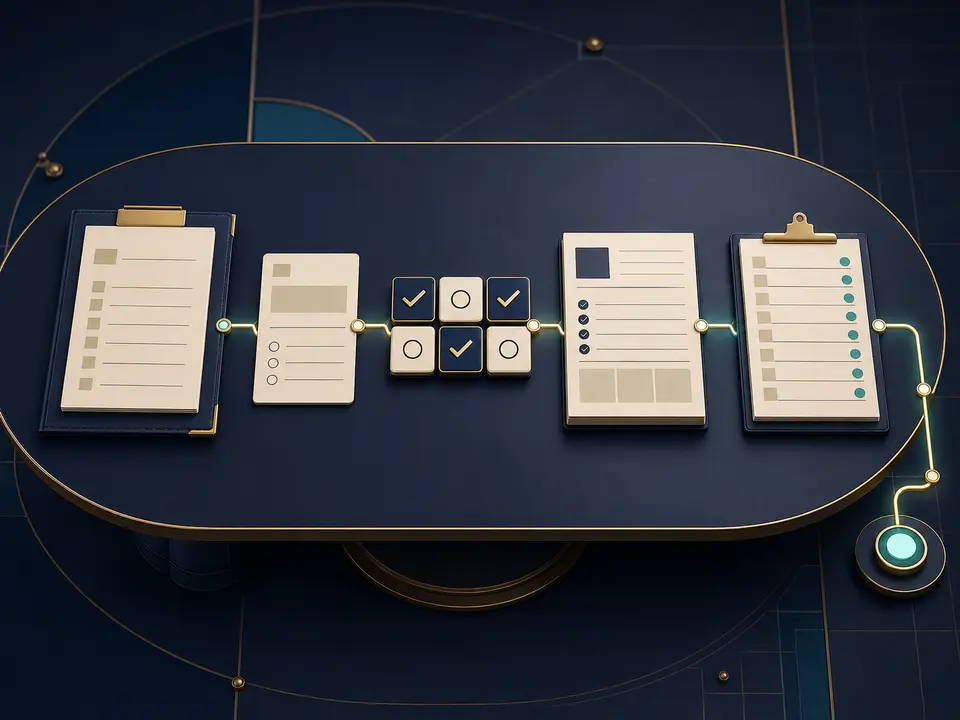
Prepare agendas, capture decisions, produce accurate minutes and transfer every action into follow-up.
Control safety and property risk without making technical, legal or liability conclusions outside competence.
Manage anger, legal threats, access, service recovery and difficult conversations without losing boundaries.
Separate allegation from evidence, stay neutral, protect safety and move formal compliance through the right authority.
Distinguish influence from authority and protect meeting, voting, proxy, confidentiality and conflict records.
Manage renovation applications, arrears, hardship, records, privacy, insurance and competing deadlines safely.
Build supervised portfolio judgement through six practical capability stages, then complete a 30-Day Management Plan capstone. The goal is not to know everything — it is to recognise risk, check authority, communicate clearly, keep the file controlled and escalate early.
Resume unfinished learning, reopen saved items and keep your verified achievements together.
Your unfinished learning will appear here.
Save a course, guide or workplace tool to keep it here.
Optional Academy learning updates are currently off.
Tell us whether the Academy is useful, builds confidence and deserves recommendation. Your response remains private to the Academy unless you separately approve future publication.
Start the six coaching courses — we will guide you along the way
Short 10–15 minute learning modules for NSW strata committee members without reproducing the full Strata Committee Guide manuscript.
The Committee Member Welcome Guide explains roles, authority, meetings, money, repairs, records and the working relationship with a strata manager in friendly, plain English.
Committee members make decisions about people’s homes, money and common property. These micro-courses explain the practical “why” behind committee work: what the committee can decide, when the Owners Corporation must decide, what records matter, and when to ask for professional advice.
Before deciding, ask four questions:
Understand delegated day-to-day authority, reserved Owners Corporation decisions, and why “the committee wants it” is not always enough authority.
Plain-English office-bearer responsibilities, meeting roles, records, levies and the difference between a role and unilateral decision-making power.
How committees should think about urgency, scope, quotes, budget, delegated authority, conflicts and documenting a sensible decision.
Understand admin and capital works funding, cash timing, arrears, commitments and why a special levy requires a general meeting decision.
What a good agenda does, how decisions are made, why minutes matter and how to disagree without turning governance into personal conflict.
Understand the difference between advice, delegation and committee instruction; set priorities; ask better questions; and create a reliable action trail.
Use these when you need a fast refresher rather than a full certificate course.
Short, warm reflections that connect everyday strata work with professional judgement—without adding another course to your day.

People experience our profession through the clarity of our advice, the care in our records, the promises we keep and the way we respond when something is difficult.
These modules fill the final launch gaps: disputes, people skills, community title, insurance and professional ethics. They are designed around practical judgement — not memorising legislation.
Know the pathway from complaint to Fair Trading mediation and NCAT, prepare a defensible evidence file, brief the committee properly and implement orders without pretending to be the lawyer.
Customer service, communication, empathy and trust: respond clearly, manage anger, say no constructively, set expectations, close the loop and recover confidence after service failures.
Understand the association, subsidiary schemes, association property, management statement, committee, meetings, levies and the differences between community title, strata and BMC structures.
Control notification, evidence, excess, scope, insurer communications and stakeholder expectations — while avoiding promises about cover that only the insurer can determine.
Authority, fiduciary duty, commissions, referral relationships, disclosure, transparency and professional judgement when interests need to be declared and escalated.
Every module uses the same professional sequence: assess risk, gather facts, check authority, communicate clearly, document the file, escalate early and follow through.
Your dedicated manager learning centre: practical judgement, financial pressure, governance, onboarding, procurement and real workplace decisions.
Know who manages governance, who manages the building, where roles overlap, and how to stop “I thought the BM was doing it” becoming a service failure.
Run the first 14 days with control: appointment, records, banking, insurance, roll, compliance, contracts, defects and missing-document escalation.
Control plan registration, developer records, meeting logistics, agenda decisions, appointment documents, defects and the transition from developer to owners.
Track term dates, authorities, renewal timing, meeting requirements, extension risk and the evidence that should always sit on the management file.
Define scope before price, compare like-for-like, disclose conflicts, check authority, manage approvals and close the procurement trail properly.
Community title is not simply “strata with different words”. Understand the association, subsidiary schemes, management statement, levies and committee terminology.
Turn a funding shortfall into a clear, decision-ready proposal. Explain the why, answer owner pushback, control the meeting and know what to do if the motion fails.
Have a training question, course idea, collaboration enquiry or something you think Strata IQ Academy should teach next? Send me a message directly.

Founder, Strata IQ Academy
NSW Class 1 Licensed Strata Managing Agent
25+ years’ strata experience
Choose the closest reason and give me a little context. Your message is sent securely to the Academy and recorded for a human response.
Training ideas, course feedback, manager development, team learning, speaking and collaboration enquiries are all welcome.
Your message comes to the Academy for review. Repeated real-world questions can also help shape future learning.
Member data is used to provide secure access, learning records, assessment history and certificates. Read the privacy notice →
Academy certificates confirm professional-development learning only; they are not legal advice, a licence or mandatory CPD unless expressly stated. Read the terms →
Review cookies and device storage, acceptable use, accessibility, learning boundaries and the complaints pathway. Open the Policy Centre →